A journey to ‘Little Tibet’
A Snow Leopard Expedition with Mattias Klum
4 – 13 December 2025
“Four! There are Four!!”
I first travelled to India, and in turn to Ladakh, in the summer of 1988 to trek and explore the remote and fascinating Zanskar Valley. The journey was a profound physical and sensorial challenge, one that left a deep impression and helped shape my enduring love for intense, immersive encounters with the wild. Shortly before departing on this most recent journey, I unearthed my diary from that time, unread for decades. Revisiting its pages filled me with a sense of rediscovery and quiet anticipation.
After a short flight north from the haze and smog of Delhi, we landed in Leh, the capital of Ladakh, a Union Territory of India, greeted by clean, cold, crystalline air. Leh sits high in the Himalayas, in the upper Indus River valley, and is known for its dramatic landscapes, ancient monasteries and formidable altitude of approximately 11,500 feet or 3,500 metres.
In my bag was a well-worn copy of Peter Matthiessen’s The Snow Leopard, taken from a shelf at home. The classic travel memoir chronicles his 1973 Himalayan journey with biologist George Schaller to study blue sheep and search for the elusive snow leopard, a 250-mile trek into Nepal’s remote Dolpo region to the Crystal Mountain at Shey Gompa.
The account weaves arduous physical travel with deep reflections on nature and self. It was only once I opened the book in Ladakh that I realised this was the same copy I had read years earlier, inscribed with my name and dated 2nd December 1998. This discovery prompted memories of another formative journey to India, this time to Arunachal Pradesh and the remote Tawang Monastery, where the Dalai Lama rested while fleeing Tibet in 1959. It felt like an ideal companion for the journey ahead and remains highly recommended.
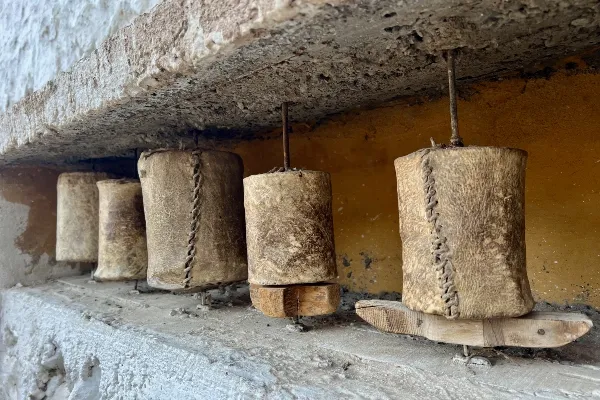
The Gateway to the Himalayas
Ladakh has a rich and layered history. Established as a kingdom in the ninth century by a member of the Tibetan royal family, it is culturally and religiously part of greater Tibet. Leh developed during this period and reached its golden age in the sixteenth and seventeenth centuries, when monasteries and palaces, including Leh Palace, were built, expanding Ladakh’s influence and significance.
Following China’s invasion of Tibet in 1950, many Tibetans fled to Ladakh, bringing with them their Buddhist traditions, which remain vibrant and deeply embedded in daily life today.
A Ritual of Compassion: Morning at Thiksey Monastery
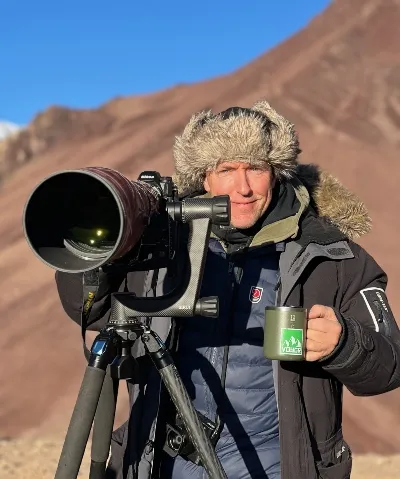
This is where our journey began with our group of twelve, including our local host Behzad J. Larry, a passionate community-based conservationist and President of the High Asia Habitat Fund, and Mattias Klum, the world-renowned photographer, filmmaker, artist and conservationist, celebrated for his work with National Geographic and other global publications.
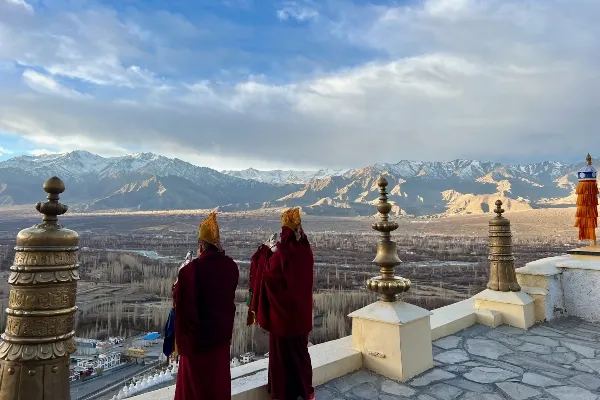
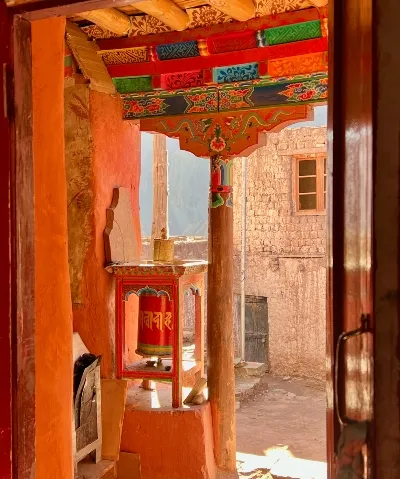
Early on our first morning, we travelled a short distance to Thiksey Monastery, a striking fifteenth-century Tibetan Buddhist monastery often referred to as the Mini Potala for its resemblance to Lhasa’s Potala Palace. Perched on a hill overlooking the Indus Valley, we were alone with the monks as they began their morning prayers. The ceremony started on the rooftop, where the deep, whirring tones of two dung-kar, horn trumpets made from natural conch shells, echoed across the valley, a sound sometimes likened to the singing of elephants. Combined with the early morning mist and the first light catching the surrounding Himalayan peaks, the experience primed our senses and emotions for what lay ahead.
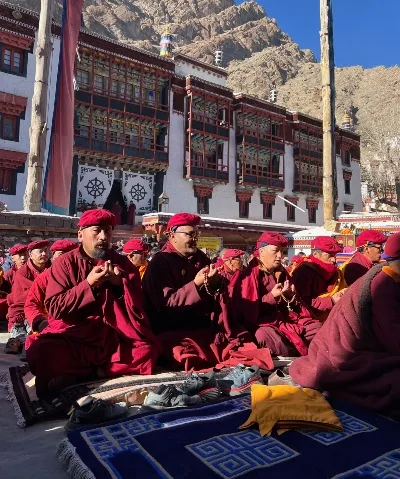
We then joined the monks below for prayers and mantras focused on compassion, wisdom and positive energy, reflecting the heart of Tibetan Buddhism. A significant part of the ritual involved receiving traditional butter tea, po cha, and food, shared between monks and visitors alike as a gesture of hospitality and collective practice. It was a humbling and deeply moving experience.
Into the Wild: Lungmar Remote Camp
That afternoon, we explored Leh itself, a place defined by its high-altitude beauty, Tibetan-style architecture, rich Buddhist culture and history as an ancient trading hub linking Tibet and Central Asia. The city offers breathtaking mountain scenery and a unique cultural blend that anchors the region.
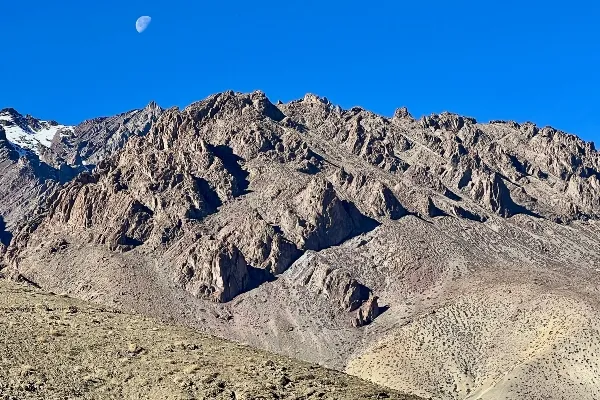
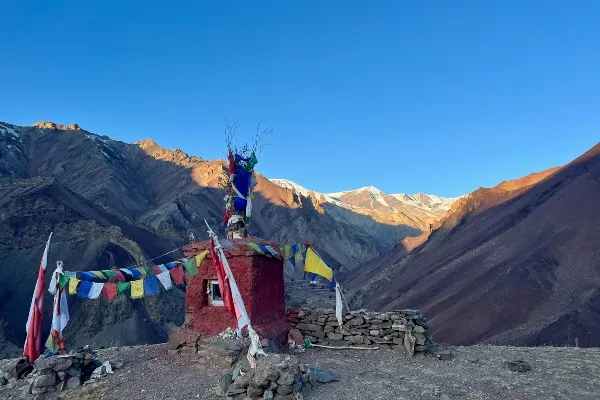
Yet the heart of our journey lay beyond the town. After two nights in Leh, we drove into the trans-Himalayan wilderness to Lungmar Remote Camp, our base at 12,000 feet or 3,650 metres, from which we would explore the surrounding valleys and mountains in search of snow leopards and other elusive wildlife. Surrounded by towering peaks and iconic red-hued slopes, the camp takes its name from the word Lungmar, whose etymology translates directly to Red Valley.
At the centre of the camp stands the Sumdo Sarai building, inspired by the caravansaries of the Great Silk Road. Here we gathered to dine, study maps and books from the specialised library, and share stories while gazing out over the mountains. Under the guidance of an acclaimed chef, the restaurant serves a simple yet delicious fusion of Silk Road cuisines, including Indian and Ladakhi specialities. With just ten rooms, Lungmar Camp is both intimate and exceptionally comfortable, offering warmth and amenities far beyond the expectations of a mountain camp.
A Sanctuary in the Clouds: Hemis National Park
The camp lies within Hemis National Park, South Asia’s largest, covering more than 4,400 square kilometres and spanning altitudes from 11,000 to 20,000 feet. The park supports an extraordinary array of wildlife, including Tibetan wolves, Asiatic ibex and Eurasian brown bears.
For the week ahead, we ventured out daily from dawn until dusk, exploring valleys and high ridgelines beneath cerulean skies and a brilliantly bright daylight moon in the west. In Buddhism, the moon symbolises purity, wisdom and enlightenment, reflecting the Buddha’s inner light. Throughout our stay, it felt like a constant, luminous companion.
Life in the High Desert: Wildlife and Coexistence
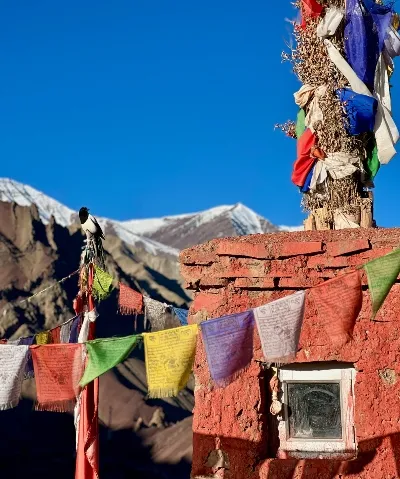
Our wildlife encounters began with numerous sightings of bharal, or blue sheep, an encouraging sign of healthy pastures and a vital prey base for snow leopards and other predators. Birdlife was abundant and diverse, with early sightings of Himalayan griffon vultures and lammergeiers (bearded vultures), followed in later days by golden eagles, chukar partridges and Tibetan snowcocks.
In a nearby village, we hiked to an old wolf trap, used as recently as ten years ago to catch wolves preying on local flocks. We spotted fresh wolf pug marks across the terrain. Much of the work led by Behzad and the High Asia Habitat Fund focuses on addressing human-wildlife conflict and enabling coexistence. Predator-proof corrals have been introduced, fortifying low stone walls with secure chain-link enclosures. The impact has been immediate, drastically reducing livestock losses and strengthening community support for conservation and the livelihoods it sustains.
The Ghost of the Mountains: An Extraordinary Sighting
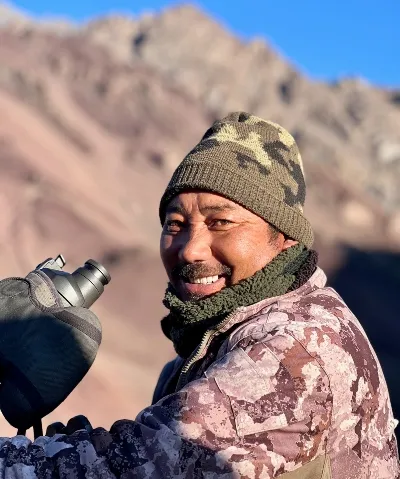
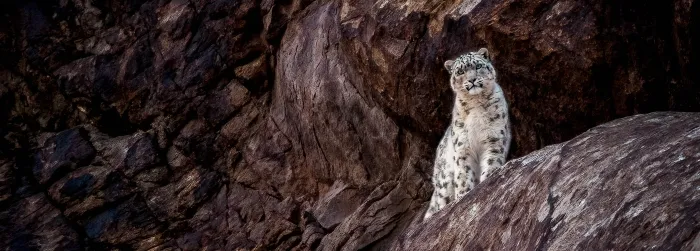
It was towards the middle of the week that our emotions really took off. Early in the morning, the local trackers spotted a snow leopard in a high pasture and we leapt into our 4×4 vehicles to drive the short distance and begin our walk to a viewing point. This was the start of an extraordinary day. The trackers established a good viewing location and once settled we began searching with our binoculars, scopes and long lens cameras. Almost instantly there was a rise in excitement as one and then two snow leopards were spotted. And then a third! There was much elation throughout the group, including the trackers. And then something extraordinary happened – one of our group exclaimed “Four! There are Four!!”.
None could quite believe this, and as the leopards were between movement and stillness, rocks and the open, in view and out of view, it was difficult to see them as a group at any one time. The trackers would not quite believe it till one of them could confirm. The minutes went by…. Then finally one leapt away from a scope, and said “Yes, there are four!”.
We spent the rest of the day basking in winter sunshine, contentedly watching the snow leopards from afar. We spotted blue sheep on neighbouring slopes and golden eagles soaring overhead, three at one point perched abreast on a distant ridge. Heaven indeed.
From their behaviour and size, the trackers determined that we were witnessing a mother with her cub from the current year, alongside two sub-adults from the previous year, still tolerated and supported by her. It was a grouping they had never seen before.
The Chorus of the Peaks: Wolves of the Warila Pass
As the week drew to a close, we departed Lungmar and Hemis National Park for the Warila Pass, one of the world’s highest road passes at nearly 17,500 feet, connecting Leh with the Nubra Valley. Early that morning, we had received word of Tibetan wolves sighted in a nearby valley. The journey took us across the mighty Indus River, one of the great rivers of South Asia, stretching some 3,200 kilometres and sustaining more than 300 million people across its basin.
As we climbed the winding road, our trackers signalled for us to divert into a side valley. Within minutes, they were pointing excitedly to a nearby hillside. Tibetan wolves, just one hundred metres away. A pack of eight moved together with effortless grace before settling at a distance to observe us. As we later spotted other individuals across the valley, the main pack began to howl. The sound was thrilling and unforgettable, a chorus used to reunite the pack, claim territory and strengthen social bonds, each wolf contributing its unique voice.
Tibetan wolves are a hardy grey wolf subspecies, adapted to high altitudes and extreme cold. Their thick, earthy coats and amber eyes are striking, and when those eyes meet yours directly, the experience is both visceral and humbling.
Moments later, another call rang out. Lynx! Across the valley, through our scopes, we watched a mother and her two cubs playfully rolling among rocks and sand on the mountainside. We also saw numerous Himalayan hares and more golden eagles, clear signs of a thriving ecosystem.
We continued on to the summit of Warila Pass to celebrate the day’s sightings, taking in sweeping views north to the Karakoram and south to the Himalayas. Awe-inspiring.
A Convergence of Spirits: The Hemis Winter Festival
From there, we descended back across the Indus towards Hemis Monastery, Ladakh’s largest Buddhist monastery, set within a dramatic natural amphitheatre of steep cliffs. Hemis is the main seat of the Drukpa Kagyu lineage and a vital spiritual and cultural centre, preserving ancient traditions, housing sacred relics and hosting significant festivals. We arrived just as the three-day Winter Festival began, with blessings and teachings led by His Eminence Drukpa Thuksey Rinpoche.
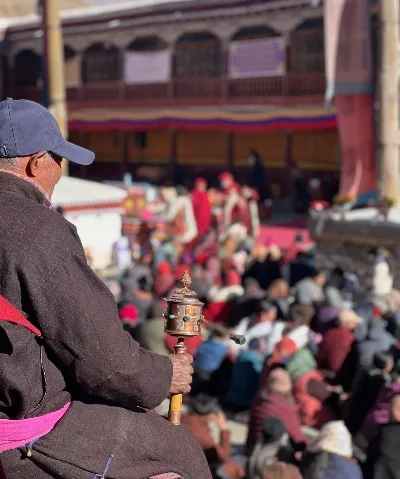
As around two thousand people gathered in the courtyard, instruments sounded and Rinpoche entered, taking his seat to begin the ceremony. Soon after, we were invited to line up, each of us receiving an individual blessing. A profound and deeply personal privilege.
The afternoon unfolded in a flow of music, chants, teachings and quiet conversations. We were a small group of foreign guests, warmly welcomed into a living tradition spanning centuries. The feelings it evoked are beyond words.
Visual Storytelling and Mission of Conservation
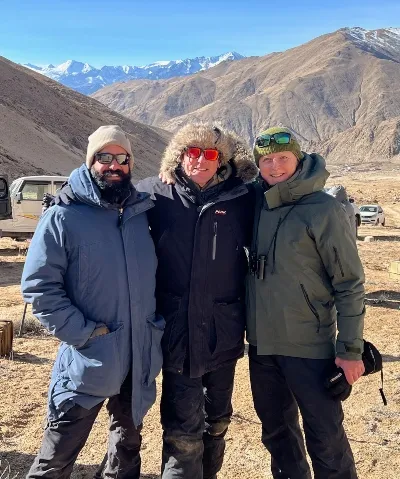
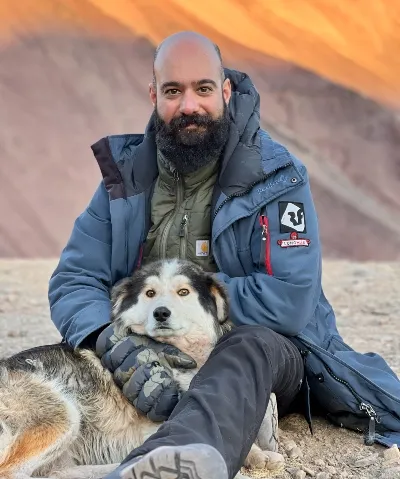
On our final night, we gathered to watch a film hosted exclusively by two world-class photographers and cinematographers, Robin Darius Conz and Ansh Gangey, who were working at Lungmar Camp on a film about Ladakh’s wildlife and snow leopards.
They shared their previous collaboration, the acclaimed 2025 documentary Nilgiris – A Shared Wilderness, a powerful portrait of biodiversity and coexistence in southern India’s UNESCO Biosphere Reserve. A brilliant film about this remarkable and little known area of India, which has the largest populations of tigers and Asian elephants in the world.
Gratitude and New Horizons
Exceptional journeys are shaped by exceptional people. My deepest thanks go to Behzad, Mattias, Dorjay, Aziz, Rigzin, Bunty, Stanzin, Sonam, Khenrab, Robin, Ansh and the entire Lungmar team for creating something truly special.
Behzad’s leadership, knowledge and care were extraordinary, and I wholeheartedly encourage support for the High Asia Habitat Fund. Through our visit, we made a direct contribution to its vital work, fully aligned with JWP’s mission.
Mattias, one of the world’s great visual storytellers, shared his experience with generosity, humour and grace. Dear friend, it was a privilege to journey together, and I look forward to many adventures ahead.
And to our guests, who made this journey possible. You are all stars.
My experiences in Ladakh now span almost forty years, and this remains one of the most treasured journeys I have ever taken. Moon, sun, stars, mountains, stillness, silence and the wild. Heaven…
Our next journey together? In search of tigers, perhaps. Or deeper still into the unknown, for the fabled and mystical yeti…
For my mother, Jean Caroline Grossart (née Howard)
23rd February 1934 – 1st December 2025
Love, Laughter, Inspiration
A boundless love of family and travel, swathed with gratitude and devotion
A bounty of gifts shared with all around her,
and that has shaped my own life and endeavours
With and without you every day, missed beyond words
OM MANI PADME HUM
Interested in conservation travel to Ladakh?
If you are looking to embark on a remote mountain adventure then get in touch with our team on 020 3544 8137 or connect@journeyswithpurpose.org.